Tree swallows are back on their house. Looking up at them I see the clear blue sky. Then I see the clear blue shoulders on the birds. Mirrors for each other, are the shoulders sky and is sky the birds? Sky and bird feed each other in their play. The sky knows itself through bird flight and the bird know itself through sky expanse.
They each fly without tracks. Only mind can see their imprints, can feel their clarity and blueness. Blessed to experience the blazing vision of swallow song and sky with a gentle breeze off the mountains. Spring morning is full of beginnings.
Thirty Spokes share one hub. Adapt the space therein to the purpose in hand, and you will have the use of the cart. Knead clay in order to make a vessel. Adapt the space therein to the purpose in hand, and you will have the use of the vessel. Cut open doors and windows in order to make a room. Adapt the space therein to the purpose in hand, and you will have the use of the room. Thus what we gain is Something, yet it is by virtue of Nothing that this can be put to use.
Chapter 11, Tao Te Ching, translated by D.C. Lau.
Have you ever looked around and seen that everything moves around its own central hub, or point and axis of origin? We could call this point the center of gravity for an object. This point and axis of origin is composed of space, otherwise looked upon and defined as Nothing. We can not define space, yet it contains everything and is singular. Space can be divided up by objects into inner space and outer space. Still there is only one space, undefined, omniscient, and connecting all objects. Space is the mother of all objects and cradles them in a warm and compassionate embrace.
The interconnection of space and movement is called emptiness and forms all objects and thoughts contained therein. Objects and perceptions do not have intrinsic, unchanging existence. Since the objects and their perceptions exist only by virtue of their emptiness, they are illusory, like the image formed by a whirling firebrand or a reflection in a mirror. Cause and effect arise from interconnections. The problem of existence is not the connections. The problem is the clinging to the connections. Gently watch the turning of objects around their space and you will see their joy at play. This joy is an unbounded expression of the limitless freedom for life.
The negative black swan events have come to roost and humans are not very happy about it. They manifest as economic market crashes, human tragedy emanating from Sumatra and Japan earthquakes and tsunamis, climate change in an ever-shifting planetary swirl of the moisture-heat-cloud-rain engine. Floods of great magnitude rearrange the land, ocean, and sky and carve new river beds and marshes. We did not notice at first, until more people became involved and compassion swelled in our hearts for those trapped by events of great consequence.
Black swan events are surprising, rare, and unexpected events of large magnitude and consequence, with dominant roles in history events that occur on the tail ends of evidence probability curves. They can be positive or negative, depending on our interpretation of the consequences that result from them and they can change the course of civilization. As such, black swan events cannot be predicted and will not be accounted for in the mechanistic conceptualization of rational scientific thinking. Science depends on the repeatable and predictable patterns of sequential events that have frequent occurrence. For rare events of great magnitude, we say they are black swan events, and then feel smug to have identified the unidentifiable, without seeing or understanding that we live in a world punctuated by rare major events with undefinable risk or benefit.
Paradigms are conceptual frameworks that encapsulate the current assumptions about how systems work. As we work out the details of a system to improve understanding and predictability, we maintain our initial assumptions until evidence shows that they are incorrect. Then we replace these assumptions with ones that more correctly reflect our evidence. With this assumption replacement, the paradigm shifts and we have a new conceptual view of the system. Sometimes the shifts are so large that the system becomes unrecognized; Newtonian mechanics to quantum physics, magic to modern medicine, alchemy to chemistry.
Black swan events can produce paradigm shifts when we are overwhelmed by our inability to explain the events and consequences of surprising, rare events. If our world view (model and assumptions) is flexible and we are not attached to outcomes of events, then our thinking and perceptions can shift and we can adapt to the new arrangement of evidence, through systems of food, clothing, shelter, work, play, sleep, families, economies, and science.
Expect the unexpected in the open space of free thinking. When assumptions are dissolved and our experience becomes assumption-free, then we can begin to live in the actual world, rather than in a world of assumption and probability. Black swan events can remind us that our world is risky and composed of changes, beyond the predictability of science and rational thought. How to think without thought? Experience, without interpretation. It takes great patience and courage to be free. Can we suspend our disbelief? In wildness is the strength of life.
Occasionally some trees are cut, because they died their natural death, they are shading too much, or they threaten to fall on something else. During a windstorm they are going to fall in the driveway or onto a garden. Or they are shading the solar electric panels and the sunscape needs to be cleared. So then the chainsaw comes out of the shed and begins its work in my hands.
The chainsaw has been with me since I began clearing the land in 1986. So we have grown older together. Younger, we used to cut all day when clearing the driveway and the lower garden. Over the years we have slowed down; not needing to cut trees and feeling relaxed about clearing, no longer keeping many paths open. Now the chainsaw likes to cut for the duration of a tank of gas and then it wants to stop. Seems like it doesn't like to run when its hot. Neither do I when I am hot. So we stop and cool off. If I take a walk for ten minutes after filling the gas and chain oil tanks, we both start up after cooling off and run for another tank.
A mirror, in the chainsaw is an image of me; getting older and taking more breaks, relaxing more. I used to just power through work and not pay attention to overheating or getting tired. Now the chainsaw reminds me to take breaks and walk around. Feel the fragrant breeze weaving through the trees and over the ferns. I could take the saw to the mechanic or me to the doctor. We would find that aging is a simply complex process and gracefully reminds us to give attention to the seasons of machines and people. This is not disease, only natural timing.
I don't want to replace the chainsaw with a newer model that will run all day. Neither do I want to replace my body with a newer model that will run all day. We can both age gracefully and be thankful for these mirrors. The chainsaw showed me its true nature the other day. In it I saw timelessness. We will make more firewood together, and keep the driveway and sunscape clear while we last. After that, the sky is boundless for both of us.
The picture shows some bones of a beaver beside Beaver Creek marsh, picked clean by scavengers. This can happen when death naturally appears after life. Where did the beaver go? Did you stop to think about who an I is? This thing that we refer to as I, the ego, is a slippery thing. We talk about I this and my that, but we really have no idea what we are referring to. Can you see I? Sure we see I as parts of something; hands, feet, toes, ears, eyes, brain, heart. But we never see I, only parts. Even in a mirror, the image is reversed. I constantly changes, like a river.
There is a contradiction in our thinking. We say that we are independent objects, beings. At the same time we say that we are subjects living in a cause and effect world. But we don't really believe this. For cause and effect to work, subjects, objects, and conditions must be connected. Our claimed I independence places us apart from others and worldly conditions and denies cause and effect. We have endless arguments and discussions about opinions based on false assumptions of independence. Cause and effect only works when there is interdependence; when things are related and connected. This relationship of connections occurs through the medium of space. We are all contained in space. We are space; ask a physicist. Just like you cannot see I, you cannot see space. You know what space is and find it everywhere. It holds you like a warm mother, connecting you to all other creatures. When you reject space as a nihilistic vacuum, you reject interdependence and cause and effect. You are alone in egoville.
Because we are dependent on space, we are connected to all other beings and conditions. Maybe our false assumption of independence is the source of so much sickness and fear. We isolate ourselves from others and from the consequences of our actions. Relax and enjoy luminous space which contains all stars, sun and moon, beings, and your thoughts as they cascade down the mountainside of your illusory ego that lost its way in independence.
The beaver lived and died in Beaver Creek marsh. Space did not make a distinction of this beaver, and simply accepted it into open arms. The beaver appeared, remained, and dissolved in space; wonderful, warm, illuminating space which comforts us all with its unbounded love and compassion.
There is a perennial christmas tree in the Beaver Creek marsh. A small mystery is maintained by joyful citizens joking around with the cultural signs and signals. It reminds me of the give and take in this world. We give our appreciation and joy to the wild. The wild gives us well being and life force. We are connected in a cause and effect manner and cannot be separated into ego-bound entities. Any attempt to claim separation and isolation is a fools errand that ends in confusion and fear. Relax and remember your birthright in wildness. The writing of this tale is on the water; appears and disappears as quickly as the breeze passes. Like breath, we constantly move the surface of our consciousness and recount the bright moments.
Meet me on the curve, where the rainbow, sky, and pure aspirations sing. We can make beautiful music together, watching the colors fade and brighten as the rain passes by our tipped hats in the morning sun.
If you can smash through a single thought,
Then all deluded thinking will suddenly be stripped off.
You will feel
Like a flower in the sky that casts no shadows,
Like a bright sun emitting boundless light,
Like a limpid pond, transparent and clear.
After experiencing this,
There will be immeasurable feelings of light and ease,
And a sense of liberation.
There is nothing marvelous or extraordinary about it.
Do not rejoice and wallow in this ravishing experience.
If you do, then the Mara of Joy will possess you.
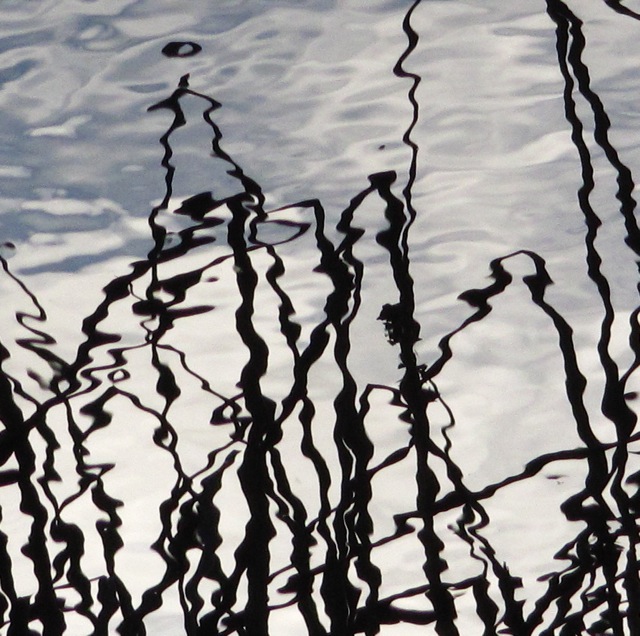
No form, form, metaphor, meaning; the marsh is filled with calligraphy. Sky, tule, breeze, water, and the writing is on the mirror. Ever changing, like pages turned in a book, we can read the meaning in the mind's eye. Struggling too much will cause the meaning to flee and we are left with an impression, like wings moving through the air, leaving no trail. This meaning of marsh writing is just like the daylight that pushes back darkness all at once. Where does the dark go? The writing speaks volumes.
Look upon the body as unreal, an image in a mirror,
the reflection of the moon in water.
Contemplate the mind as formless,
yet bright and pure. Not a single thought arising,
empty, yet perceptive;
still, yet illuminating;
complete like the great emptiness,
containing all that is wonderful. - Han Shan Te'-Ch'ing, 1600
One of the advantages of being with the marsh is the shaping of intention. This cryptic statement exposes the power of the marsh and other natural places. Being in nature, next to the marsh, beach, or walking in the forest lifts our spirit and mood. This lifting arises from the wonder and suspension of thinking that we experience in the presence of what cannot be immediately understood. Our intention is lifted with the mystery of the marsh. Seeking to know the marsh, we name and locate items that compose the marsh. These objects change with the season and weather, and the marsh remains, an unknown, mystery that is clearly apparent.
Intention is important because it is the stage in our thinking where we can control outcomes. Once thought has left the stage of intention, it is surrounded and shaped by material objects and tends to be limited by their potential. Intention is only limited by the heart. If our intention is positive, then positive outcomes will result. If our intention is neutral or negative, than neutral or negative outcomes will result. The mystery of marsh and other natural places gives us the space to shape positive intentions. When we are surrounded by negative intentions, such as aggression, greed, attachment, jealousy, and fear, then our lives are filled with objects and outcomes that reflect these intentions.
In this season of light, where we all celebrate the winter solstice and the returning of the light through various religious or spiritual rituals, take time to shape intention towards love, kindness, peace, and good will towards all beings. Walking with nature can facilitate this intention-shaping by reminding us that we are part of a powerful world that depends on intention and the outcomes that flow from intention. Our most powerful actions are the shaping of intention, as they control the placement of objects and outcomes in our lives.
When we are feeling good about ourselves and the world, then everybody is a friend. When our mood is low and dark, then enemies and trouble stalk our spirits. We have the choice. Shape positive intention before being carried away by negative emotion. Keep forming positive intention until the world is filled with positive thoughts and outcomes. They will shape the future and our legacy.
We rely on reflections to see. Everything that we see appears as objects, beginning as light reflected from object mirrors into our eyes. We assume from habit that objects are real and this assumption is reinforced by other perceptions of sound, touch, taste, and smell. All of these perceptions through other senses are also reflections; sound waves, neurotransmitter waves, and smell and taste particle waves.
Reflections come with various levels of distortion associated with the wave structure of their transmission. When we look at objects and their reflections in water, we see all of these aspects. An object directly appears as solid and not wavering. The reflected object appears as wavering, dependent on the effect of breezes on the water surface. The reflected object color also changes, dependent on the water colors. Who is to say which object is more real? The object and its reflection are both reflections that have different qualities. We assign realness based on our visual biases learned from years of observation. Are we seeing a real object?
Our real object appears to be a reflection that we favor, while we reject the wavering reflection. This ambiguity of real and illusory reflections is the great pathway into our true nature. We can find the singularity where the object and its reflection meet. Look along the bank of a creek or pond. There is the seamless transition between object and its wavering reflection. They are both reflections, joined by the continuity of light received from each, into our eyes and then transmitted to our brains by waves of neurotransmitters, reflections of nerve energy. Our true nature lives in that line between reflections, where symbol and meaning meet. The nature cannot be seen and is experienced directly in a continuum of awareness, not bound by reflections and their mirror surfaces.
Relaxing our perceptual biases gives us the freedom of wildness. Our thoughts are free to dissolve into the warm sunlight that may be hidden behind the clouds of seeming objects; mirrors of light intended for perceptions. Objects are mirrors and we are echos of reflection from those mirrors. The singularity of the shoreline, the horizon of our perception, the surface of the mirrors, is our consciousness; that which brings together object, subject, and perception. In all these echos, how can one hold an opinion? We are all the free play of light and energy.
We experience timeless awareness when our consciousness recognizes the unity of object, subject, and perception. This recognition happens on the singularity of the mirror surface which is unchanged by the reflections emerging from it. That mirror surface is everywhere and we call it space.
The creek flows through the marsh and out into the ocean, surrounded and suffused by space. There are many examples here of what is clearly apparent yet not existent. We can call these examples metaphors and symbols for the nature of things. We objectify our existence, separating ourselves from other objects and beings and declare us and them. Objects and subjects are like a creek in its bed, wind in space, waves on water, reflections in mirrors, clouds in sky, and dreams in sleep. Objects and subjects are illusory as they have no independent, lasting self-nature and are interdependent in a web of cause and effect. This very dependence is the appearance that we call object and make philosophy and science with. Since we are not omniscient, we are not able to see all of these causes and conditions. We believe strongly in the independence of objects, as if they were separate and distinguishable, and say that they have self-nature. We especially have a strong sense of ego; that we are independent, with self-will.
The ego is like the emperor in the story of “The Emperor’s New Clothes”. Two (duality) tailors (illusion) weave clothes (objects) for the emperor (ego) that are so light and fine (desirable) as to appear invisible (no cause and effect), especially to anyone too stupid or incompetent (shame) to appreciate their quality. A child (original nature) eventually saw the emperor in his new clothes and recognized that he was naked. But the emperor could not acknowledge this nakedness (awareness) and continued on, walking through the streets (the world) with the illusion of his new clothes.
How deluded we are. By maintaining this separation of subjective self and objective other, we fail to see what is. We grasp on to solidity of self and objects as if they did not constantly change and depend on each other. Even if we recognize change, we do not believe that it applies to our precious self and others. We are afraid when objects change, as this represents loss and gain of something desirable or abhorrent. We fail to see that birth, life, and death are a continuum, with the magical properties of spontaneous appearance and disappearance of consciousness that are dependent upon subject and objects. This cycle rests upon unchanging awareness, which we sense but cannot see. We are this awareness, which gives rise to the display of subjects and objects; just like waves forming and dissolving into water, reflections arising and disappearing in mirrors, clouds forming and dissolving into sky, and dreams appearing and disappearing in sleep. The water, mirrors, sky, and sleep are metaphors for awareness and are not changed by this display. Recognizing the illusory nature of display, we can return to our nature and be complete.
When we are not attached to our conclusions, concepts, and training about existence, then we are free to experience our nature in the vast ocean of space which is mind. We easily move through the causes and conditions that surround us. Then we become what we are, omniscient awareness in the unending web of interdependence. Everything is as it should be in the unending dance of change. Relax and enjoy every emotion, thought, and perception as the illusions that they are, without the anxiety of grasping and fixation.
Scenes from the opening night of the art show at the Newport Visual Arts Center, Upstairs Gallery. Paintings, ceramics, photographs, pastels, and sculpture are on display through October, 2010. Five artists, Sandy Roumagoux, Liisa Rahkonen, Nancy Jane Reid, Jackie Niemi, and Michael Davis show works inspired by the Beaver Creek State Natural Area. The natural mind of wildness is invoked in the gallery, which is filled with light and life in the colors of marsh.
Reflections reveal our nature, as light is returned to us from objects, waking and dreaming; all are mirrors. We name these reflections perception, emotion, and thought. We forget that everything is clearly apparent, but not existent. We objectify that which is simply reflection and call it the world. At the marsh, we are real and bask in the glow of the singularity that is our love for all beings and places. We are alive and know it in our hearts.
Thirty years ago, I had a conversation with Range Bayer about what he calls patient watching. We talked about the interesting and different behavior that can be seen when observations of animals are made over a relatively long period of time. Our conversation had a profound effect on me. Going on to study fish behavior, I used what Range had said about patient watching. Recently, Range and I talked about patient watching again and remembered that this method is indeed a powerful way to see the world. Range used patient watching in his studies of great blue herons.
In classical behavior studies, the observer may watch an individual for short periods of time, generally 15 minutes or less. This is called focal study and several individuals may be observed to gather replicate data for statistical analysis of mean individual behavior in a population. The watching is done with an eye towards recording occurrence and duration of previously determined stereotypical behavior such as agonistic displays, feeding, and courtship. This behavior is often collected into an ethogram and data is recorded that reinforces these conceptual frameworks.
What happens when the observer watches an individual for an hour, or several hours, or through tidal cycles for up to 12 hours? We no longer simply see stereotypical behavior that was preconceived. We begin to see atypical, non-stereotypical animal behavior in the context of their environment. We see how the individual responds to constantly fluctuating environmental conditions and in relation to other animals that may enter or exit the perception space of the focal individual. This diversity of behavior is a new window on the animal and is a rich source of hypotheses and eventual explanatory information about how the animal behaves. These patient watching studies are difficult, as they require a good deal of patience, sitting quietly for long periods of time while maintaining attention on the focal animal. Try sitting and watching the same bird for an hour. You must be comfortable, maintain attention, and make reliable notes for later reference and quantification. This is the natural activity of one who meditates. A great blue heron is a master of this mediation in the marsh, while looking for food and avoiding conflict with other animals.
When we use patient watching, we choose not to look specifically for predetermined behavior, relaxing assumptions about what we might see. We choose to openly watch for any behavior that may occur, repeatedly or infrequently, over a wide range of environmental and social conditions for the animal. There are few, if any, patient watching behavior studies documented in the scientific literature. I am making an effort to find these sorts of studies, as they are a unique contribution to knowledge of animal behavior and its meaning in ecology. Patient watching studies can give the big picture for animals.
How can we use patient watching in our lives? We can gain perspective on the events and circumstances of our lives by seeing through the lens of extended time. By not automatically applying short-term conceptual assumptions to our observations, we can begin to see directly and sense the underlying forces that shape our actions and thoughts. Imagine the potential power of seeing the wider field of connections among emotions, objects, people, and animals. This may be a new source of inspiration and wealth, akin to the power of wildness to bring us contentment and well-being. It would certainly help us discern the differences among conceptual seeing and direct seeing that often cloud our knowledge. Maybe we would not be so quick to jump to conclusions about our world. This could help reduce bias and prejudice.
The season has changed into Autumn and we witness the slow decay and death of summer life as the light angle is lowered and rain approaches. It is a time of great leveling and return; a remembering of the equanimity of birth and death in nature. This season is one of reflection and understanding for the power of dissolution and return to the source.
“Whatever appearances manifest are equal as sense objects; simply what is evident to the sense faculties. Whatever thoughts arise are equal as mental events; simply conscious states that leaveno trace. Both are equal in the moment; simply the bonds of denial or affirmation. In actuality, they are equal in the final analysis; nothing but appearances that have nobasis. Sense objects are equal in their distinctness; upon examination simply leaving no trace. Ordinary states of consciousness are equal in essence; upon analysis nothing but space. Objects and mind are nondual; simply pure open space. Whoever understands things in this way is a descendent of Samantabhadra; a sublimespiritual heir of the victorious ones, a master of awareness in the highest sense."
Longchenpa wrote these words.
Autumn is a mythical time in which we can see the dying, death, and dissolution of summer life. We enjoy the bountiful harvest of summer’s growth and we give thanks. From ancient times through to now, the allegory of alchemy has illustrated this cycle of birth, death, and dissolution through the seasons. We can see this in the marsh and forest colors. Stage 1 is Blackening, in which putrefaction occurs with reduction to pure material. Earth and water are freed. Stage 2 is Whitening, in which sublimation occurs with discovery of reflected inner light, the moon, water of life. Stage 3 is Yellowing, which is a return to complete purity with direct light from the sun. Stage 4 is Reddening, which is coagulation, a return to form.
The cycle of seasons can be stated as processes; Calcination-form to ash, Dissolution-ash to water, Separation-water to essence, Conjunction-essence to recombination, Fermentation-recombination to new being, Distillation-new being to increased purity, Coagulation-pure being to precipitation of new body. These processes can occur through the evident connections of elements and qualities. Earth is cold and dry. Water is cold and moist. Fire is hot and dry. Air is hot and moist. These elements can change into each other through the qualities they have in common- cold, hot, dry, and moist -based on the primal material and awareness. We have discounted our perceptions of elements and qualities in favor of scientific views which objectify the worlds and separate us from them. When we stand before the marsh we see earth, water, fire, air, and space in wildness. Why not use these metaphorical expressions to explore the inner space of awareness and the consciousness of objects that are clearly apparent; arising, remaining, and dissolving so easily, spontaneously. Happy autumn and best wishes for an abundant harvest.
Bright day on Beaver Creek. Being on the water reminds of me of how we see. The world is composed of five movements; earth, water, air, fire, and space. Everything else is elaboration on these movements and added complexity to satisfy our longing for knowledge. Of course we talk and think about science and the chemical elements with their atoms listed in the periodic table. We say that objects and beings are composed of atoms that are subject to the laws of physics and chemistry, as if this explained what we see and do. Even further in our conceptual cave, we talk about quantum physics and the particles that make up atoms, until reaching the ultimate particles. Then finally we move into the space-time continuum and attempt a grand unified field theory of everything. At the end of the day, we are still in a boat, paddling up the creek, with life but a dream.
In any event, what we see and respond to are the five movements. So paddling on Beaver Creek through a sunlit afternoon actually immerses us in the theory of everything; spontaneously and all without effort. We do not arrive at any conclusions about the nature of the universe and we are relaxed into the rhythm of sun sparkles and waves. This is the reality that wave-particle theory of atoms and photons aspires to. As we feel the imposed separation of subject and object that science assumes, there is a deep emotional reaction that yearns for understanding our source and meaning. This source is wildness and the five movements; earth, water, air, fire, and space. By actually thinking and creating art in the forms of the five movements, we may recognize our nature. Consider the center of a wheel. It is undefined, yet pervades all wheels. The center is everywhere, undefined and pervasive. We are like this center, moving through a dream world of perceptions and images that are spokes on a wheel which becomes organized by our movements. Deconstruction will drive you crazy with endless details. Reconstruction will set you free, whole again.
We see our visual world through reflected light in the mind. This light can be captured and explored through photography. By looking at the seamless boundary of object and reflection, we can see the continuum of mind, which is luminous space. The sun appears in water as a thousand reflections (sparkles); so too colors and shapes appear in mind. Reflections reveal our nature, as light is returned to us from objects, waking or dreaming. We name these reflections perception, emotion, and thought. Calmly looking, we can see that mind is not altered by its perceptions, just as mirrors are not altered by reflections. All apparent and hidden things (this and that) arise from, rest on, and dissolve into radiant space, which remains unchanging. Our world and us in it are reflections in the vast mirror of space, the lucid and radiant mother of all. We are not separate from our reflections; like the sun reflected a thousand times in water is not separate from the radiant sun in space.
Michael is a retired aquatic biologist after 35 years of making science. He researched and published on botany, wetlands biology, biogeochemistry, fish behavioral ecology, and stress.